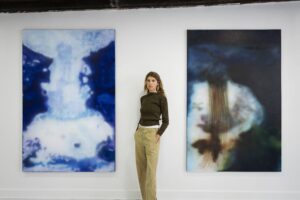
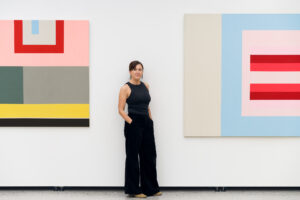
[caption id="attachment_295" align="aligncenter" width="506"] Michael Johnson, Studio Image[/caption] Studio Notes May 7th, 2013 Michael Johnson has had a long time to think about geometry. If you ask him to discuss the difference between a circle and a square he will refer to astronomy rather than the picture plane. The law of intersection between horizontal and vertical is where he is working and there is a great deal of room to play in this zone. In this spirit are new works that confounded what many had come to expect from his painting and on first view it was a challenge to try and reconcile what looked like three different exhibitions in one studio. Seeing the new work for the first time, there were two large paintings that looked like monumental 'classic' Johnsons many smaller oil studies that had the architectonic rigidity of his 80s paintings and drawings, and then a body of anthropomorphic works that were (apparently) like nothing he had ever created before. I mean CIRCLES! And Flat colour and allusions to the human body. This was shocking for a geometrically purist, often lyrical, but resolutely abstract painter. But after about two more visits, and a quick recollection of the Matisse retrospective at MOMA in the 90s, a rationale began to surface. Johnson said: "Sometimes in a series of work I have to leave the ocean and vast river and side track up the creek of my past work to be borne back into ideas and places I have not fully digested: drawings, quick studies, calligraphy, work made in hotel rooms etc..." [caption id="attachment_294" align="aligncenter" width="529"]
 Michael Johnson, Celestial Auorora, oil on canvas, 245 x 213c, 2013[/caption] So, some of these works serve as the artists? retrospective back pages and all of them seem to function within a continuum of works talking to each other across time. In my view, the first essential point of this show is to apprehend it as an expression of the artist's rights. The right to shatter existing frameworks. The right to experiment and ultimately the right to struggle to innovate rather than produce in a facile way. And doubtless mastering a new language at 75 is not simple. The genesis of the anthropomorphic works in this show can be found in sculptures that Johnson has been creating since the 60s using small balsa wood boxes painted with different planes of solid colour. These small sculptures have never been exhibited but have been dotted around his studio and traveled with him for years. They are experiments in colour, form and spatial dynamics. Johnson has also been drawn to the circle, the ellipse and the arc from his earliest landscapes through to the very graphic gouache studies he made in Paris in the late 80s/early 90s. The forms in these drawings (again rarely exhibited) had a hand torn quality and perhaps also shared a link to the liberty and scale of Matisse's collage cut outs of the 1950s. Inside and outside is a relationship that Johnson refers to a great deal when discussing a composition. That interplay of foreground and background, interior and 'view' is found in Matisse and Bonnard and doesn't seem an obvious preoccupation for an abstract painter but it is definitely an issue in works where the fields of colour are flatter and the forms are much more distinct. The human body is also something that surfaces in this series. In the 70s Johnson worked a great deal with modern dancers. The 'line's they created when warming up and improvising are things he refers to conversationally and you can intuit that energy in many aspects of his work: either in a large curving form that looks like a torso or in the jagged frenetic line that quavers over a large abstract composition. One thing this artist often say's about his work is "it's physical!" and the energy that drags a line of pure colour is driven by intense physical effort. So he might argue that his body is in every painting even if the results are completely anti-figurative. Johnson also has talismans that have been preserved, treasured and carried with him through life. Sacred stones, gathered, piled, simply held in the palm are always in the studio and so some are featured in these paintings. And then he also has favourite forms. Shapes that perhaps are evoked in other paintings but never literally drawn. The circle is always contained within the square; it is almost the shadow of the world we have built around us. And like Leonardo's Vetruvian man all movement occurs within the circle. The square represents order, it 'contains' imagery and it frames reality. But the circle always alludes to the infinite. Indian music is circular and Johnson listens to a great deal of it while he works. Spiritually he has always been drawn to both Islamic and Tantric art, both disciplines that revere the spiritual potency of the mandala and the endless archway. All of these preoccupations are at play in these works. This series was also created as finite. Like a symphony all notes and ideas are contained within each 'act' of each painting. Taking three years and substantial risk, (he described it as "Taking the risk with love"), Johnson had specific ideas to explore and engage outside his known tropes. A predominant theme and element is water. "Tidal waves, tsunamis, whirlpools, water spouts, geysers" all have been named by Johnson as driving the forms in these paintings and generating a fluidity of both shadow and contour. Johnson's studio walls and floors are dotted with the most diverse photographs, taken on the road, torn from magazines and they can be of animal fur, sunsets, sandstorms, Indian erotic sculpture, ancient Chinese ceramics or water lilies. In the large abstract works these visual cues are translated into pure colour. ?Notes? he calls them and he means that in both the visual and musical sense. But in the anthropomorphic series the references are teased out. Those yearning for a figurative experience might find a sleeping animal, a bubbling spring or a patch of sky but essentially that is lazy thinking. Johnson has never aimed to represent nature and instead he has mutated its diverse sensations into a highly personal visual lexicon. Often what he wants to convey is an intense physical or emotional state and that is romantic in a sense but it is also, essentially, abstract. The German expressionist painter Emil Nolde painted the sea but he was painting in the firmament of fascist repression. That specific social context changed the landscape deeply. As a political exile Nolde was separated from his homeland by a body of water. So was he painting the sea or the emotional state of isolation created by the water's edge and the view beyond reach? This is much closer to my father's way of thinking. IE: we are looking at a spectacle of beauty but many different concurrent conditions are at play and a good painting and a good view share the same revelation, namely they spin the senses into a state of questioning, unknowing and rediscovery. We are looking through, interrogating, sometimes yearning. Three different bodies of work in this show ask to you to dig. Through Johnson's back catalogue, through his desire for geometric discipline and through his most lyrical outbursts. It would be boring but efficient to map the chronology of every form in this show, when it is much more useful and quite openly joyful to see the anti-chronology of ideas converging or even clashing. Out of the studio, ventilated by light and space the works are less congested and competitive. The compressed impossible meetings of colour can breathe and the forms that looked orphaned or anachronistic speak to silence. Sixty years of drawing are in the rigging. Countless broken studies fallen to the studio floor build the middens. Internal arguments, compositional tensions and colour experiments persist. But the essential patience of discipline and pained private ritual succeeds to dissolve in the light. "The inspirations can be very sophisticated and refined or they can be simple. In the works with symmetrical, playful scaffolding I was looking at my grandson's drawings and thinking about the way children use pattern to make sense of the world or give strength to a drawn structure. You can look at it that way or you can see echoes of my very minimal drawings form the early 70s. The studio is not just a place where work is completed. It is a laboratory and some things remain open, unresolved or...completely impossible to resolve." By Anna Johnson