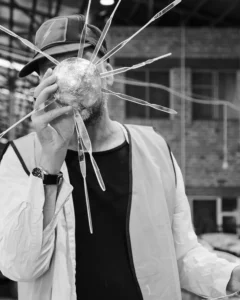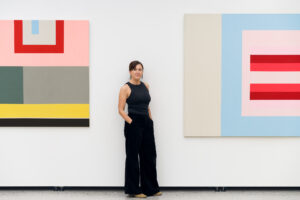

Museum visits the ceramics studio of Woollahra Small Sculpture Prize finalist Stephen Bird.
Museum visits the ceramics studio of Woollahra Small Sculpture Prize finalist Stephen Bird.
Below is an (incomplete) inventory of the various articles splayed across tabletops and walls and on the floor of artist Stephen Birdâ??s Alexandria studio; a strange sort-of work complex that sits above a Harvey Norman warehouseâ??you canâ??t install kilns just anywhere these daysâ??and is apportioned between several ceramic artists and sculptors.
Here is what I see:
There is a wall, covered in Birdâ??s jocular and carnal and eye-poppingly surreal plates. Plates that ask you questions like â??Whatâ??s for my dinner tonight?â?? Plates with half-eaten ceramic biscuits affixed to their edges; biscuits that look like the Arnottâ??s Nice variety, sweet and dusted with granulated sugar. Rich, glistening navy plates bordered by golden sperm, featuring a man clutching his dick and wearing nothing but a wristwatch. There are plates with what look like Birdâ??s striding figure, flattened out and striding forward, surrounded by scores of mini plates. Bird refers to them, for the most part, as â??quick one-liners.â?
Here are the other things around us: a wedge of yellow sponge, cleaning equipment, a hand-painted, splotchy container that reads â??Fatherâ??s Dayâ?? and is stuffed with paintbrushes, an orange scalpel, gloss-finish varnish, a sign straight from the Rugrats credits that spells â??KILN ONâ?? in cartoonish letters, a shallow tray filled with clay balls in two hues (Bird gestures to a sculpture where the colours are fused: â??that face is terracotta and white mixed togetherâ??I do it as I go to achieve certain skin tonesâ?).
The other thing in front of me is Stephen Bird himself, who is congenial and welcoming, if a little hard to readâ??until he breaks out into a smile or a loud guffaw, his expression is somewhat inscrutable. The UK-born artist spent much of his youth in Stoke on Trent, a city often dubbed â??the Potteriesâ?? for its industrial-scale manufacturing of creamware and bone china. This is the place where Wedgewood, Royal Doulton, Spode and Mintons began; quintessentially British companies that made fancy plates and quaint figurines to be kept behind glass. Bird also spent time in Scotland and still keeps a second studio in Dundee.
Birdâ??who began as a painterâ??was not interested in ceramics until much later.
â??No, no, I thought they were horrible things. Sometimes you grow up with something and you donâ??t realise its value.â?
The photographer, Douglas Lance Gibson, interjects.
â??Like, I grew up with profiterolesâ??â?
Bird lets out a chortle.
â??I did! I lived in country NSW, about 100 kilometres west of Dubbo. Tuckshop day was on Fridays and the mothers would rotate who was on staff. One would bring a croquembouche of profiteroles. The school only had 50 kids and this became a regular thing. I mean, my mother never made them, but Rhonda Richardson made them.â?
*
Birdâ??s sculptures take a few weeks to develop. Sometimes, he can finish in one. â??You have to work quickly with clay. Thatâ??s long days thoughâ??12 hours a day. And the pieces are very improvised.â? We walk to the kiln where a sculpture is partially fired. On a nearby shelf are figurines by Birdâ??s two children: R2 D2, Darth Vader, a miniature lightsaber. In the kiln is a piece partially modelled on Saturn, the Greek god, and partially on Birdâ??s great-great grandfather, a sheep farmer named Ralph Reid. â??Iâ??ve done a whole series about an ancestor of ours who came from Scotland, went crazy and killed himself. Iâ??ve been trying to chart that descent into madness and despair.â?
Little is known of Reidâ??s emotional state prior to his suicide, and Birdâ??s tribute sculptures and plates are imbued with imagined histories. â??We didnâ??t even know where the body was until my cousin found the unmarked grave. Sheâ??d go round to all the farms asking if they had any gravestones on their property. One [pointed her to] this leaned-over gravestone the cows used as a scratching post. It was pretty big, seven or eight feet tall. Iâ??ve been there. Itâ??s hard to find, youâ??ve got to get in a four-wheel drive vehicle and go across a field.â?
The final work we view is the totemic Figure of Self-Reflection, Birdâ??s entry into this yearâ??s Woollahra Small Sculpture prize. He has put it in a separate room. Here, itâ??s bathed in daylight. A bird-man fusion, standing at 71 centimetres, it looks like a painting by Giuseppe Arcimboldo, stacked with repeated heads and lego pieces and egg yolks and slippery ripples that look like baked beans. â??I had lots of little clay moulds [in my old] studio,â? says Bird. â??I was almost going to throw them away and then I thought, you know what, Iâ??ll make one more piece out of the detrius. It grew out of that process.â?
Just before our interview, Stephen Bird had returned from Beyond Limitations, a four-week mentoring and residency program in Korea. One of his mentees, the Melbourne-based Fred Fowler, started making ceramics after watching YouTube how-to videos. â??Itâ??s how I started making ceramics, pre-YouTube days,â? says Bird. â??I just thought Iâ??d give it a go.â? Bird also works as a lecturer at The National Art School in Sydney. In November this year he will have a solo show at Olsen Irwin.
Read full article here .