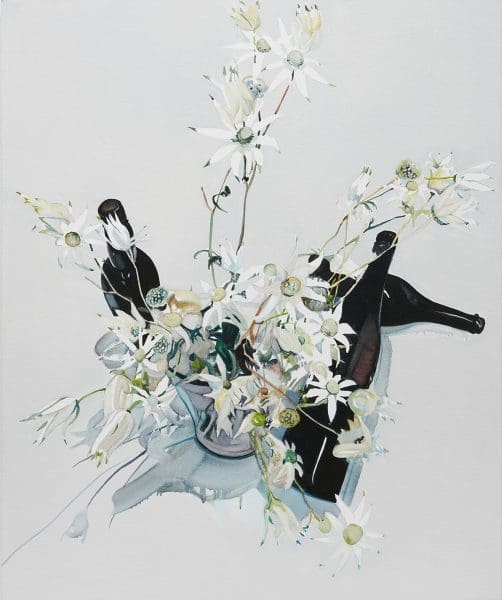
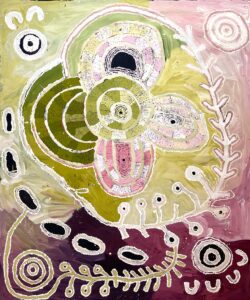
Julian Meagher, There is Light Somewhere, 152 x 246 cm. Oil on linen. 2016.
Article by Varia Karipoff, 2 March 2017
His story has been told numerous times across media ? often with just a lingering hint of incredulity. Julian Meagher completed a medical degree before embarking on a career as a painter. Though in truth his interest in art never waned, somehow finding time to undertake a classical education in portrait painting at Charles H Cecil Studios in Florence, midway through his medical studies. Over the course of 15 years Meagher has notched up an Archibald moment (he was a finalist in 2014 and 2015), won a slew of grants and prizes, and exhibited in places as far afield as India, Singapore and LA.
In his painting, Meagher is conscious of the disconcertedness and darkness beneath our ?radiant Southern Cross.?
Working in thinned down oils he captures the pellucid blue light and reflective surfaces of his childhood upbringing on Sydney Harbour?s foreshore ? albeit in unexpected objects. The metallic tones of a bloated cask wine bladder, or a family of empty alcohol bottles knocked over like skittles and adorned with native flora are just two examples of his uniquely Australian work. In the resulting still life, national perceptions of masculinity and addiction, and even the violence that precipitated lockout laws are cast back at the viewer from the painted surface. In his latest exhibition, a gentler, more optimistic tone comes to the fore.
Varia Karipoff?Your inroad into the art world was somewhat unorthodox ? how did it unfold? Julian Meagher?I have always loved painting and been surrounded by it since I was a kid, spending a lot of my teenage years taking extra art courses and also studying for a year over in Italy at an art school. I then completed a medical degree at university in my early twenties before deciding to pursue art professionally. VK?What compelled you to change direction after completing your studies in medicine? JM?I finally grew some balls. I am kind of happy though that I was more mature and experienced when I started out. Without discipline and drive it?s very hard to work through the highs and lows of making paintings.
VK?Can you describe how you work? JM?I think my main influence actually came from family. My mum is a painter and was always taking us to galleries, and my uncle was a die hard collector. I did spend a lot of time by the water growing up, and began to realise even then that each area in Sydney has quite a dark and often unrecognised past underneath its immediate aesthetic beauty. I guess I am still working out my place in this city and its history. Julian Meagher, Study for There is Light Somewhere, 117 x 96 cm. Oil on linen. 2016
VK?Previously your paintings chronicled eastern tattoos and exotic birds, why has your lens turned inwards to Australian culture? JM?To be honest it is the narrative of paint and space itself that is the overriding joy I get from making work, regardless of subject matter. However, I do think Australian culture is becoming more important to me as I grow up and want the country to grow in the right direction as well. VK?Tell me about your upcoming show at Olsen Gallery ? what can we expect to see? JM?The title of this show [There is Hope to the Last Flower] is a quote from an apiarist discussing the plight of bees. Faced with so many sad and distressing events in our world, and my own sense of hopelessness at times, I wanted to paint a show about optimism. This show includes portraits and still lifes touching on many disparate subjects ? ranging from friends? addictions, the recent lockout laws, Australia?s identity, our environment, love and my recent marriage. When I look at things I see so many reflections.
VK?The works from the Olsen show are very patient studies in light, transparency and reflection ? we can definitely see the optimism coming through. JM?I hope so. The economist Paul Romer recently described optimism as both conditional and complacent. The feeling a child experiences while waiting for a present is complacent or passive optimism. Whereas conditional optimism is when a child that wants a tree house realises, that if he gets the materials and friends to help him ? he can then build it himself. I think I am trying to engage in conditional optimism whenever I can in many aspects of both life and studio practice. Painting in its pure form is a great example of this. As painters we can decide where to shine the light. VK?In your paintings of goon bags the line between humour, beauty, critique and celebration is blurred ? why did you choose this derided object as a focus?
JM?They are great objects to paint, so damn solid but at times also threatening to float away. It is hard to beat translating such a symbolic object into a thing of beauty. VK?Often objects or figures are grouped in your work in a way which suggests a landscape, although your paintings are practically always interior, or at least devoid of background detail. Are you conscious of a tension between still life and landscape in your work? JM?I guess I do see each work as a kind of constructed landscape. I am actually about to undertake a residency with Bega Valley Regional Gallery in which I am looking forward to painting a landscape series. It will be interesting to see what comes out of that. VK?Coming from a studio-based practice, how do you think you will approach landscape painting? JM?To be honest I have no idea. Most of my recent landscapes have ended up in the bin. I am actually hoping that the environment there will help me push through these failures into something special.
VK?What else are you looking forward to this year? JM?Becoming a father. VK?What is something that you have seen or read recently that has had an impact on your practice in some way? JM?Sapiens by Yuval Harari is a book that I think should be essential reading for everyone, it is one of the best entry points into the history and mechanics of humanity. Also, the David Hockney exhibition at the NGV just blew me away, his passion for mark making, perspective and his willingness to experiment are elements I have tried to bring more to my own practice.